Innovative energy technologies in Austria – market development 2009
Results for the biomass sector
Authors: Peter Biermayr, Rita Ehrig, Christoph Strasser, Manfred Wörgetter
Published by the Austrian Federal Ministry for Transport, Innovation and Technology
Motivation, method and content
The documentation and market research in the field of technologies for the exploit of renewable energy sources creates a basis for the planning and decision making in politics, economy, research and development. The aim of this market study ”Innovative energy technologies in Austria – market development 2009“ is to lay a foundation in the following fields: biomass, photovoltaics, solar thermal and heat pumps.
Methods used are: questionnaires handed out to manufacturers, trading firms and installation companies as well as questionnaires of funding providers at the national and local governments. Furthermore information is gathered with a survey of literature, the evaluation of available statistics and internet research. The obtained data is displayed in time series to provide the starting point for deeper analysis and strategically considerations.
First the market development is illustrated by production numbers or installed capacities and then the energy gain is calculated taking into account the life cycle of the machinery. The necessary support energy for the main and auxiliary machinery is discussed and savings in gross and net of greenhouse gas emissions are calculated. The graphically displayed turnovers and the job creating effects show eventually the impact of the various technologies in Austria. Results are shown in alphabetical order of technologies.
Introduction
Like numerous other fields of economy in 2009 the development of renewable energy sources suffered from detrimental influences. The strong trend of heating systems based on renewable energy sources was reduced due to the damped investment climate as a result of the financial and economic crisis, the low price of crude oil and last but not least an initiative of the Austrian mineral oil industry to support new oil-fired heating systems. Despite these facts the Austrian market remained crisis-proof. Reduced sales were often the result of problems with the export market. The interior market stagnated in many fields on a high level of sales. Using planned marketing initiatives in the field of photovoltaic installations a historical record sales figure was achieved in the interior market.
Solid biomass - fuels
The energetic utilization of solid biomass has a long tradition in Austria and is still a very important factor within the renewable energy sector. The consumption of final energy from sold biofuels increased from 142 PJ for 2007 to 158 PJ for 2009. The consumption of wood chips is increasing steadily since the beginning of the1980s. For 2009 the wood chips consumption with 71.5 PJ has exceeded the consumption of wood logs with 67.2 PJ. The very well documented wood pellet market developed with an annual growth rate between 30 and 40 percent until 2006. This development was then stopped 2006 due to a supply shortage which resulted in a substantive price rise. But meanwhile the production capacity of 15 Austria pellet manufacturers has been extended to 1.66 million tons a year and this resulted in a market recovery.
Fuels from solid biomass contribute to a CO2 reduction of almost 14 million tons for 2009. The whole sector of solid biofuels accounted a total turnover of 1.142 billion Euros and 12730 jobs.
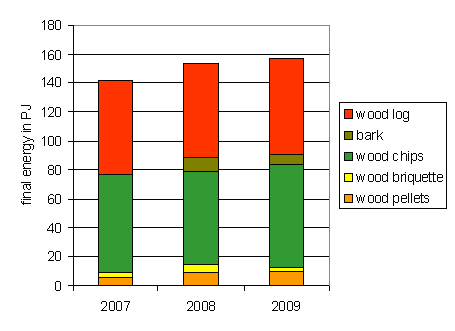
Figure 2.1: Market development of different biomass fuel types from 2007 to 2009 in Austria; Source: BIOENERGY 2020+.
The further development of forest based solid biofuels is determined by incremental improvements for technology, logistics and distribution. Agricultural based solid biofuels are characterized with a higher yield and have the potential for carbon sequestration. Their deployment is currently at the beginning and demand for further research activities.
Solid biomass – boilers and stoves
The market for biomass boiler has increased steadily from 2000 until 2006. A market break of more than 60% occurred 2007 with low prices for heating oil and the mentioned supply shortage of pellets. For 2008 the sales figures reached again the level of 2006. For 2009 a reduction of sales about 24% was documented due to low price level of heating oil and subsidies given by the Austrian mineral oil industry for new oil boilers.
The Austrian market comprises of 8449 pellet boilers, 8530 wood log boilers and of 5032 wood chip boilers for 2009 concerning the whole range of power. Furthermore 4131 pellet stoves, 8118 cooking stoves and 23129 wood log stoves were sold. Austrian biomass boiler manufactures typically export approximately 70% of their production. In Germany for instance two out of three installed biomass boilers are of Austrian origin. Germany and Italy are the biggest export markets for Austrian companies. The biomass boiler and stoves sector obtained a turnover of 1.002 billion Euro in 2009. This resulted in a total number of 4763 jobs. Research efforts are currently focused on the extension of the power range, further reduction of emissions and the reduction of the consumption of auxiliary energy.
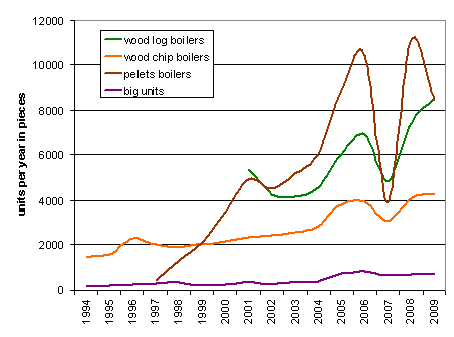
Figure 2.2: Market development of biomass boilers from 1994 to 2009 in Austria;
Source: Agricultural Chamber Lower Austria 2010.
Full study in German (with English summaries) available here:
http://www.nachhaltigwirtschaften.at/publikationen/view.html/id797
Contacts regarding biomass-related chapters:
Rita Ehrig
Christoph Strasser
Manfred Wörgetter
2010-06-21